If you’re here, chances are you’ve heard whispers about the Yoto Player. Maybe a friend swears by it. Maybe you saw it floating around Instagram or tucked into a Montessori toy shelf. Maybe someone told you it helps kids fall asleep easier or makes car rides quieter or magically reduces screen time.
And maybe now you’re wondering:
What IS this thing?
Do we need one?
Is it really better than a Toniebox?
What does it actually DO?
Which version should I buy?
How do the cards work?
And how much content do I have to buy?
This guide is everything I wish I had known before purchasing our first Yoto Player four years ago — and then buying a second one quickly after because… well… siblings.
Think of this as your practical, honest, no-fluff, real-parent guide to Yoto.
Let’s get into it.
WHAT IS A YOTO PLAYER?
A screen-free audio device… but also kind of a childhood game-changer.
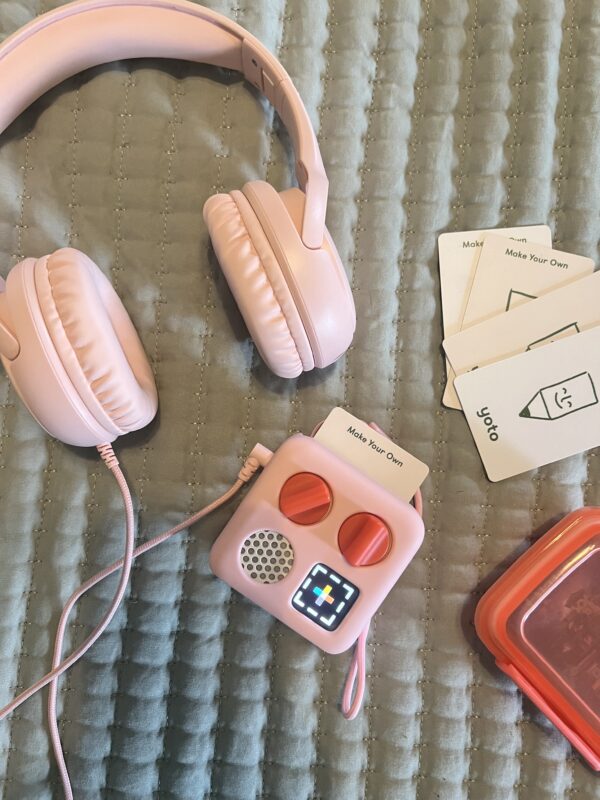
A Yoto Player is a screen-free smart speaker for kids. It uses physical audio cards (yes, real cards the kids insert themselves) to play:
- Audiobooks
- Music
- Educational content
- Kids’ podcasts
- Radio stations
- Sleep sounds
- Meditations
- Mindfulness tracks
- And more
It’s designed to be kid-led, meaning your child can use it on their own without navigating screens, menus, or apps.
That’s the magic:
It gives kids independence without overstimulating them.
The device itself has:
- Two knobs (volume + tracks)
- A pixel display that shows cute animations
- A slot for cards
- Built-in WiFi for downloading content
- A surprisingly good speaker
Once a card’s content is downloaded, the Yoto can play it offline, which is essential for car rides, travel, and “the WiFi is acting weird again” afternoons.
WHAT’S THE DIFFERENCE BETWEEN THE YOTO MINI AND THE FULL-SIZE YOTO PLAYER?
This is one of the most common questions — and the answer is simple once you see the chart below.
Yoto Player (Full-Size)
Best for: Bedrooms, bedtime routines, family listening
Key features:
- Larger speaker = better sound
- Built-in nightlight
- Sleep timer + alarms
- Lives mostly in one place (bedroom/playroom)
- Needs to be plugged in
Yoto Mini
Best for: Travel, cars, errands, kids who love portability
Key features:
- Small enough to throw in a backpack or coat pocket
- Surprisingly loud for its size
- Long battery life
- Offline listening
- Perfect for on-the-go adventures
So which one should you buy?
If you want a bedtime hub → Full Yoto Player.
If your kids listen everywhere → Yoto Mini.
If you want both… many families end up with both.
In our home, we own two Minis because portability is everything for us — and they’ve been perfect.
HOW DO YOTO CARDS WORK?
This is the feature that makes Yoto magical and incredibly kid-friendly.
There are two types of cards:
1. Pre-Made Yoto Cards
You buy them through Yoto’s online store or retailers.
These include:
- Chapter books
- Picture book retellings
- Music (Disney, classical, pop, lullabies)
- Mindfulness
- Calm-down tracks
- Science + learning content
Pop the card into the player → the audio begins → the audio is now downloaded → you can take the player anywhere.
These are durable, portable, and clutter-free (each the size of a credit card).
2. Make-Your-Own (MYO) Cards
These are blank cards you can customize in endless ways.
You can add:
- Audiobooks you own
- Spotify/Apple Music playlists (converted)
- MP3s
- Kids’ podcasts (downloaded legally)
- Family recordings
- Stories read aloud by YOU
- Meditations
- Class notes
- Affirmations
- White noise bundles
- Study skills
MYO cards are reusable. If your kid outgrows something, just replace the content.
This is something Toniebox cannot match.
MYO cards are:
- Cheaper
- Less bulky
- More flexible
- Truly customizable
In our house, MYO cards are the most-used cards.
Especially for:
- Bedtime playlists
- Travel podcast bundles
- “Grandma’s bedtime stories”
- Study cards for early readers
HOW DO YOU GET CONTENT ON THE YOTO?
This is where Yoto becomes more than “just an audiobook player.”
There are several sources of content:
1. Yoto Store Cards
You can buy physical cards that ship to your house. These are great for gifts or building a curated shelf your child can flip through.
2. Digital Cards
You can buy content digitally inside the Yoto app.
It behaves just like physical cards — you can assign it to a card or play it from the app.
3. Yoto Daily
A free, daily mini-podcast specifically for kids.
It’s adorable, quick, age-appropriate, and my kids LOVE it.
This is the number-one thing that transforms errands and school drives.
4. Yoto Radio
Yes, Yoto has radio stations.
Music, kids’ stations, chill tracks — all streamable any time.
5. Make-Your-Own Uploads
Anything you legally own can be uploaded into your library.
This adds a TON of flexibility and longevity, especially for older kids.
HOW DOES THE YOTO APP WORK?
This is the part that surprised me — in a good way.
The app lets parents:
- Assign content to cards
- Preview content
- Download stories for offline use
- Adjust volume limits
- Set bedtime/sleep timers
- Change the brightness of the pixel display
- Start or stop audio remotely
- Play content without the physical card
- Manage both kids’ Yotos separately
The app is the control center.
But the kids?
They rarely need it.
That’s the beauty.
It’s a parent tool, not a kid tool.
WHY DO FAMILIES LOOK FOR YOTO IN THE FIRST PLACE?
(And why we did, too.)
Most families want:
- Less screen reliance
- Calmer bedtimes
- Quieter mornings
- Independent play
- More reading exposure
- Sensory-friendly support
- A way to make car rides easier
- Storytelling without overstimulation
- A device that doesn’t require supervision
Yoto meets all of these needs without feeling like a chore chart or a parenting hack.
It just integrates naturally.
We first looked for a solution because:
- We were drowning in screen requests
- Bedtime battles were exhausting
- Ollie needed richer stories without reading pressure
- Lillie needed story access without confidence pressure
- Car rides were chaos
- We wanted independence without more screens
Yoto delivered on every single one — but more than that, it made our home feel calmer and more connected.
IS YOTO BETTER THAN TONIEBOX?
This is the question Google gets asked thousands of times a month.
Here’s the simplest, clearest, most honest answer as a parent who’s used both:
Toniebox is better for toddlers.
Ages 18 months–3 years thrive with Tonie’s simplicity and figurines.
Yoto is better for ages 3–12.
The content grows.
The player grows.
The independence grows.
The listening stamina grows.
The flexibility grows.
If you want something that lasts for YEARS, get a Yoto.
There’s a reason most families who start with Tonie eventually switch.
PROS AND CONS OF YOTO (REAL TALK)
Pros
- Huge content library
- Grows with kids from toddlerhood to preteen
- Portable (especially the Mini)
- Screen-free
- MYO cards = unlimited flexibility
- Great for bedtimes
- Great for quiet time
- Great for car rides
- Great for independent play
- Encourages reading development
- Durable and kid-friendly
- App gives parents full control
Cons
- You will want more cards
- You may end up buying a second player for siblings
- Some content can get pricey if you impulse-add to your library
- Requires WiFi for initial downloads
Still, the long-term value blows most kids’ tech out of the water.
WHO IS THE YOTO PLAYER REALLY FOR?
After four years of living with two Yoto Minis, here’s my honest take:
Yoto is for:
- Kids who love stories
- Kids who struggle with reading
- Kids who need sensory-friendly routines
- Kids who wake up too early
- Kids who fall asleep easier to sound
- Kids who love music
- Kids who need independence
- Kids who get overwhelmed by screens
- Families who travel
- Families with neurodivergent kids
- Families who crave calmer routines
If you nodded at even one of those, a Yoto will probably serve your home beautifully.
FINAL THOUGHTS: PRACTICALITY MEETS MAGIC
Yes, the Yoto Player is practical.
Yes, it’s flexible.
Yes, the content is rich.
Yes, it’s durable and thoughtfully designed.
But the reason it matters?
It brings story back into the everyday moments of childhood.
The big moments like bedtime.
The small ones like riding to Target.
The quiet ones like coloring after school.
The stretched ones like long car rides.
The soft ones like waking up slowly instead of to a screen.
This guide gives you the practical side.
But in our home, the Yoto gave us both the practical and the magical.
Because life is too ordinary to ignore the extraordinary — and sometimes extraordinary looks like a tiny screen-free speaker that fits into your kid’s hands and opens up entire worlds.