When you’ve been raising kids long enough, you learn there are purchases that come and go—the trendy toys, the educational gadgets, the things that promise the world and deliver a shrug—and then there are the purchases that stay.
They become part of your home.
Part of your rhythm.
Part of your family story.
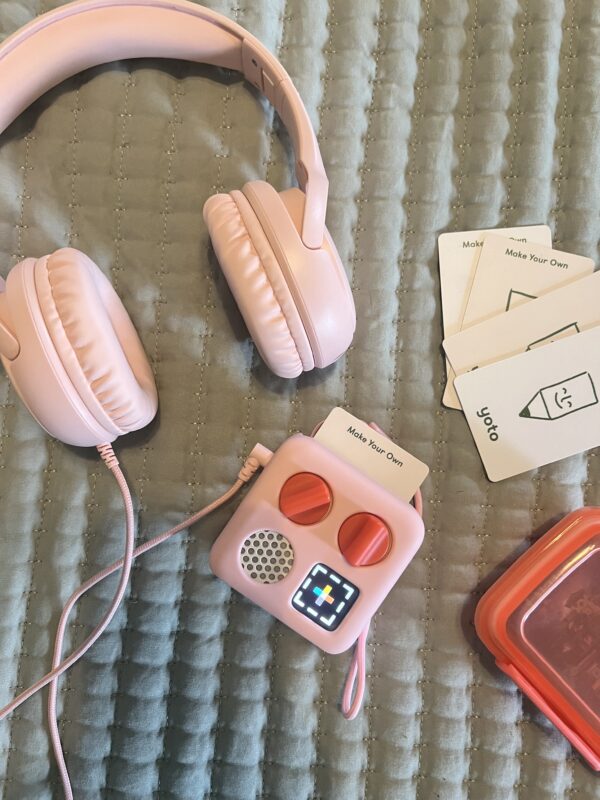
The Yoto has done that for us.
But we didn’t begin this journey as diehard Yoto evangelists.
We began as curious parents trying to solve a problem—and one of the biggest questions we faced early on was the same one so many parents ask:
“Should we get a Yoto or a Toniebox?”
We’ve owned both.
We’ve used both.
We’ve lived through the strengths and limitations of each.
So this part of the crash course isn’t abstract.
It’s lived-in, real, and rooted in the everyday magic (and chaos) of raising two very different kids.
Let’s talk about why, after years of use, Yoto became the clear winner for our family.
Where We Started: Toddlerhood, Simplicity, and the Tonie Era
Toniebox is charming. Truly.
Those chunky little figurines? Adorable.
The throw-it-across-the-room-and-it-still-works durability? Impressive.
The ease of use for toddlers? Fantastic.
If your child is between 18 months and three years old, the Toniebox feels like the perfect fit.
It gives them:
- A tactile, toylike experience
- Easy, no-buttons-required activation
- Short, gentle stories
- A soft cube that feels like a plush speaker
And for that stage of life?
It genuinely shines.
But here’s the part many families don’t realize until later:
Kids grow up fast.
And the Toniebox… doesn’t grow with them.
The Problem We Ran Into: Outgrowing the Toniebox
As Lillie and Ollie got older—past preschool, into kindergarten and early elementary—it became clear that Tonie’s content library just wasn’t going to keep pace.
Here’s what we saw:
1. Stories skew young.
Most Tonie figurines are built for the preschool crowd.
2. Limited variety.
Music, short stories, a few chapter book options—but not enough depth for kids 5+ who crave more complexity.
3. Figurines everywhere.
This is not a minimalist toy system.
It is adorable clutter.
4. Make-Your-Own Tonies are clunky.
You can record or upload your own content, yes, but the experience is not as seamless—or as flexible—as the Yoto’s MYO cards.
5. Portability is limited.
Toniebox must be downloaded at home, and while it can be used offline, it’s not compact. It’s not bag-friendly. And it’s not made for older kids who want audio on the go.
Of course it still had value.
Of course it still had moments of delight.
But it was clear:
Our kids were ready for something bigger.
And that’s where Yoto entered the picture.
Why Yoto Fits Kids Beyond Toddlerhood
The moment we brought home our first Yoto Player, it became obvious that it was built with long-term childhood in mind.
Where Toniebox thrives in ages 2–4,
Yoto thrives in ages 3–12 (and honestly, beyond).
Here’s why.
1. The Content Library Grows With Your Child
This was the gamechanger.
Yoto’s library isn’t just “good for kids.”
It is robust, layered, and organized by age range—from toddlers to tweens.
There are:
- Chapter books
- Classic literature
- Contemporary kids’ novels
- Educational audio
- Mindfulness and music
- Family podcasts
- Sleep meditations
- Adventure stories
- Mystery stories
- Emotional regulation content
- Radio stations and daily content
When your child is growing—and growing fast—this matters.
This meant that Ollie, who wasn’t ready to pick up thick chapter books but was absolutely ready to enjoy deeper narratives, finally had a medium he could stretch into.
And Lillie, who was building reading confidence slowly, could still enjoy the rich world of stories without feeling left behind.
Tonie had nothing comparable for their ages.
Still doesn’t.
2. Make-Your-Own Cards Are Far Superior to Make-Your-Own Tonies
I’m going to say it plainly:
Yoto’s Make-Your-Own system is the best in the industry.
With Yoto MYO cards, you can:
- Upload your own MP3s
- Add music
- Add audiobooks
- Add podcasts
- Add recorded stories
- Add affirmations, meditations, anything
- Rearrange or update content anytime
- Replace the content whenever you want
- Keep it all on one slim, clutter-free card
It’s exactly the kind of freedom older kids need.
Lillie has playlists she loves.
Ollie has podcast bundles.
We even have cards labeled “Grandma’s Bedtime Stories.”
With Tonie?
The process was more restrictive.
More complicated.
Less flexible.
And the figurine format made storage a headache.
This wasn’t just a convenience improvement.
It was a quality-of-childhood improvement.
3. Portability Matters More Than We Expected
We are not a stay-at-home-all-day family.
We’re in the car.
We’re out running errands.
We’re going to Target, dance class, sports, the grocery store, school pickups, always moving.
The Yoto Mini was made for families like us.
It’s:
- Tiny
- Durable
- Fits in a backpack or coat pocket
- Works offline
- Has great battery life
- Easy for kids to carry
And because it works without WiFi once content is downloaded, we can listen anywhere:
In the car.
In the backyard.
In waiting rooms.
Standing in line.
Walking through Target.
At Grandma’s house.
On road trips.
On airplanes.
Toniebox simply can’t match that level of freedom.
4. Yoto Encourages Autonomy for Older Kids
This is something I underestimated until I saw it:
Yoto empowers kids to manage their own listening.
They turn the knobs.
Choose the card.
Start the story.
Pause the story.
Control the volume.
Pick the music.
Pick the mood.
There is no screen.
No login.
No algorithm pushing content.
No endless menus.
Just kids engaging with stories on their own terms.
With Toniebox, we were still steering everything for too long.
But with Yoto?
My kids became the drivers of their audio world.
That independence is priceless.
5. From a Value Perspective—Yoto Simply Goes Further
This is where practicality meets emotion.
Tonie figurines are cute but expensive.
And each figurine = one story or playlist.
With Yoto:
- Cards are cheaper
- MYO cards are endlessly reusable
- Digital content is regularly discounted
- Yoto Daily is free
- Yoto Radio is free
- The app unlocks flexibility
- You don’t have to keep buying figurines
The long-term value is significantly higher.
But beyond the financial side, the value for your child’s growth is deeper.
Yoto supports:
- Reading development
- Listening comprehension
- Emotional regulation
- Independent play
- Creativity
- Calming routines
- Screen-free habits
When you zoom out, it’s not just cost.
It’s impact.
6. Emotionally, Yoto Fits the Kids They Are Becoming
This is the part Toniebox can’t compete with—because it’s not about technology.
It’s about growth.
Yoto fits:
- A child learning to love stories
- A child who is reading slowly
- A child falling in love with chapter books
- A child who needs sensory downtime
- A child who processes the world through sound
- A child who wants independence
- A child who wants to explore big stories
- A child who’s outgrowing toddler toys
It fits the real complexity of kids ages 4–12.
It fits Lillie.
It fits Ollie.
It fits who they are now—and who they’re becoming year by year.
So… Why Did We Choose Yoto?
Because Toniebox was perfect for who our kids were.
But Yoto is perfect for who our kids are becoming.
Because the content grows with them.
Because the device grows with them.
Because their imaginations grow with them.
Because story grows with them.
And because, in our home, Yoto didn’t just replace a device.
It replaced struggles.
It replaced stress.
It replaced clutter.
It replaced bedtime battles.
It replaced morning chaos.
It replaced the “Can I have a screen?” spiral.
And in its place?
It planted magic.
The ordinary kind we always talk about.
The everyday kind that changes everything.